An investigation · 18 pages
The Bottle Is the Product
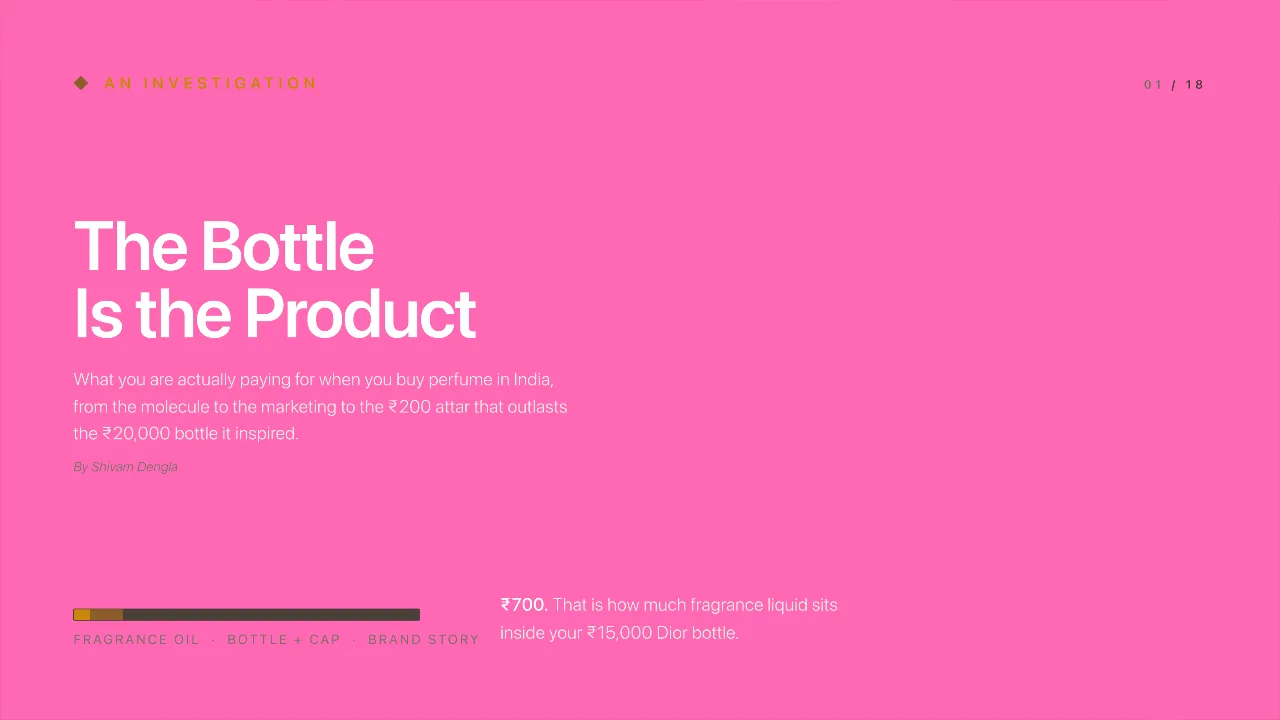
What you are actually paying for when you buy perfume in India — from the molecule to the marketing to the ₹200 attar that outlasts the ₹20,000 bottle it inspired.
4.7%
Of a ₹15,000 designer bottle is the fragrance liquid itself — about ₹700. Marketing costs five times more.
The thesis
You sprayed ₹15,000 of Sauvage at 9am and couldn't smell it by 1pm — and blamed yourself. You shouldn't: the perfume was designed for Paris at 22°C, not Mumbai at 40°C and 85 % humidity. Follow the money and the molecules, and luxury perfume stops being mysterious.
Inside the deck
- 01
Four companies make the molecules. None of them are Dior.
Givaudan, IFF, Symrise and DSM-Firmenich supply 55 %+ of all fragrance raw material on earth. They sell to Dior, to Bella Vita, and to the man filling bottles in Kannauj. The same supply chain, three very different price tags.
- 02
Where ₹15,000 actually goes
Liquid ₹700. Bottle ₹1,400. Import duty ₹3,500. Marketing and celebrity ₹3,500. Retailer margin ₹3,600. The thing you smell is under five percent of the thing you paid.
- 03
Same bottle, two climates, two perfumes
In Paris the base note lasts eight hours; in a Mumbai summer alcohol evaporates 30 % faster and the base is gone by lunch. Heat, humidity, sweat pH and pollution compound — the format itself is climate-mismatched.
- 04
The city that was forgotten
Kannauj documented attar production in the 9th century; Grasse emerged 300 years later. Today European houses buy Kannauj rose absolute as raw material — India exports the ingredient, France builds the story, and the ingredient comes home in a ₹20,000 bottle.
India exports the ingredient. France builds the story. The ingredient comes home in a ₹20,000 bottle.
Reading this and hiring for product? Email me — say what you disagreed with.