Consumer brand casebook · Goa, est. 2017 · 2026 · 18 pages
Maka Di
How a Goan craft brewery built a beer company in the one market the government runs.
3 L vs 70 L
Beer per person per year, India vs the Czech Republic. The lowest consumption on earth is not a ceiling — it is the runway.
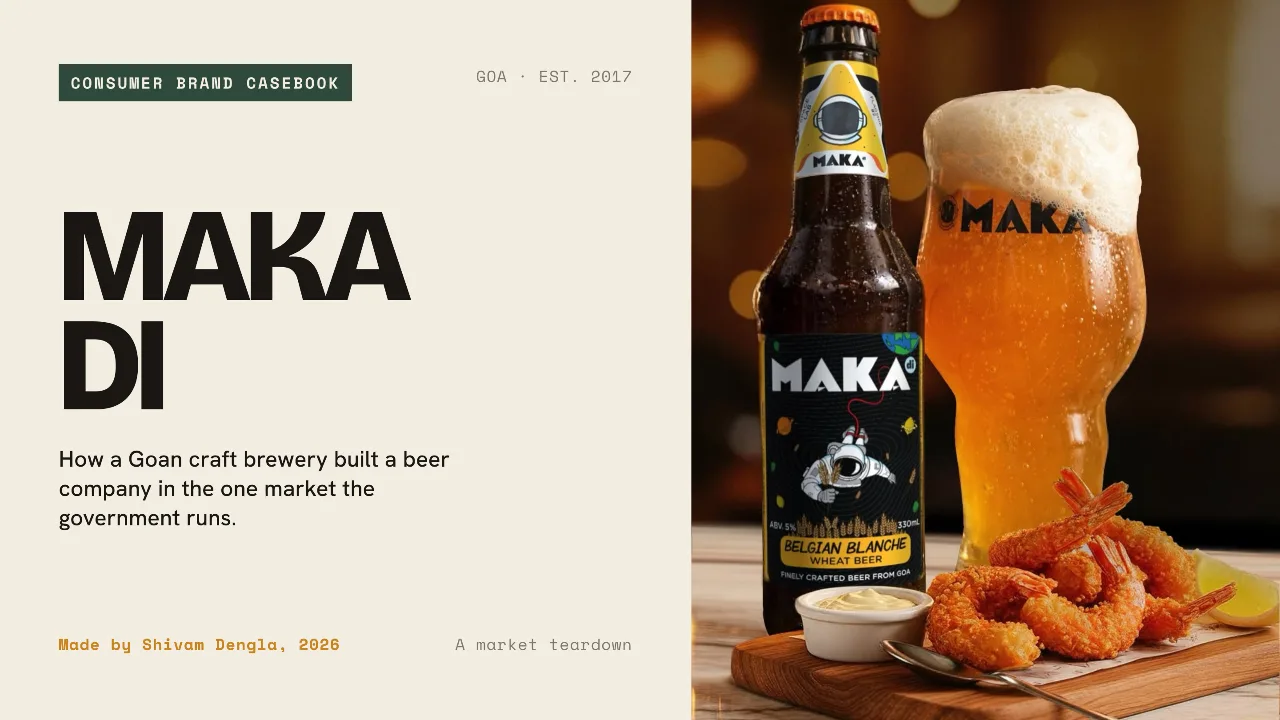
The thesis
India barely drinks beer, taxes it harder than spirits, and lets state governments run the market — and that is exactly the opportunity. Latambarcem spent three years building the plant and the R&D before a single bottle sold in 2020. The moat was poured in concrete before it was poured in glass.
Inside the deck
- 01
Beer is four ingredients and one fragile step
Malt, hops, yeast, water — and a packaging problem, because beer is exquisitely sensitive to oxygen: under 30 parts per billion in the bottle. Easy to make, brutally hard to keep.
- 02
Eight beers map one ladder
A ₹79 Goan rice lager drives volume, a ₹99 shandy is the gateway, the ₹110 Belgian Blanche is the best-seller, and a ₹160 Belgian Tripel carries the medals. Every SKU buys credibility for the next one up.
- 03
Super Maka: the 15 % loophole
Indian law caps beer at 8 % ABV — go above and you're legally wine, taxed on a friendlier ladder (₹40/L vs ₹60/L in Goa). One bottle delivers what four mass lagers do, at roughly 30 % EBITDA while mass lager sells at a loss.
- 04
Goa is a manufacturing advantage, not a vibe
The cheapest brewing license in India (~₹25 lakh vs ₹17 lakh per label economics elsewhere), low-TDS groundwater for a product that is 90 % water, 12 hours to Bombay port, one plant equidistant from Bangalore, Bombay and Hyderabad.
The moat was poured in concrete before it was poured in glass.
Reading this and hiring for product? Email me — say what you disagreed with.