Product innovation case study · 10 pages
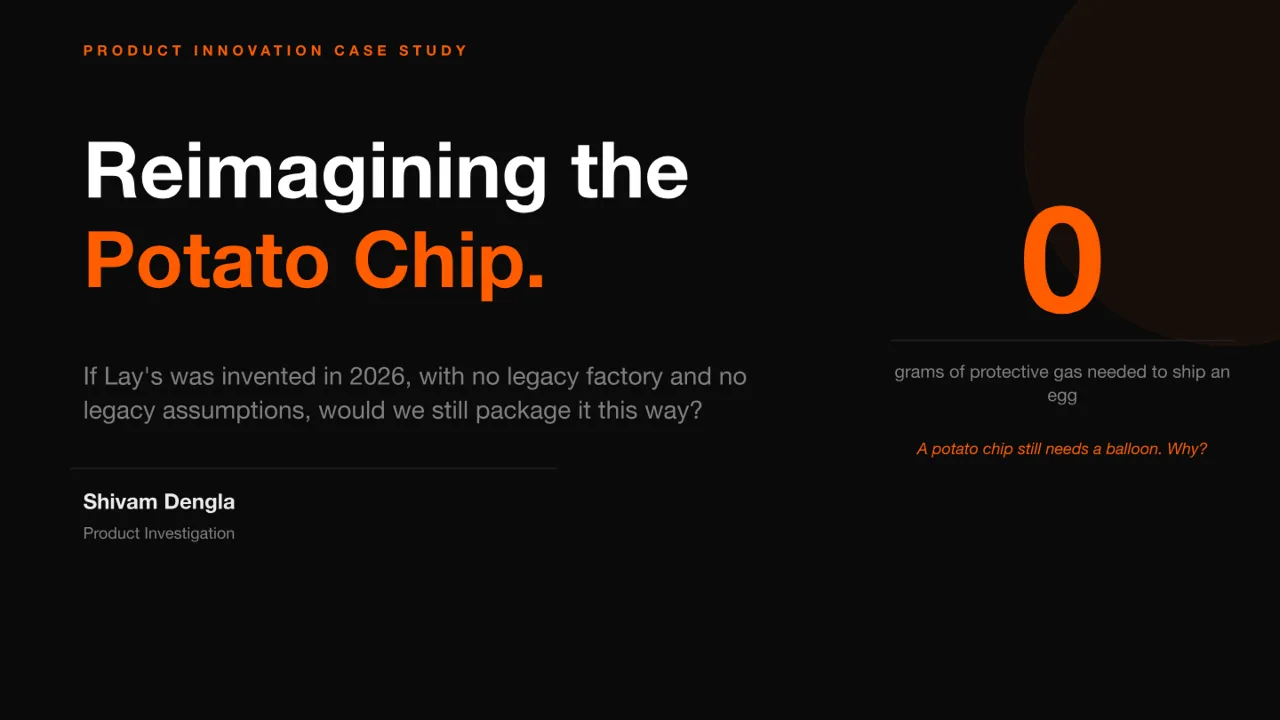
Reimagining the Potato Chip
If Lay's was invented in 2026, with no legacy factory and no legacy assumptions, would we still package it this way?
~60% air
Of every chip bag ships and stores nitrogen, not chips — a brilliant 1965 answer nobody has re-asked since.
The thesis
An egg — the most fragile food we ship — travels with zero protective gas. A potato chip still needs a balloon. The bag isn't badly designed; it has just never been redesigned, because the chip industry only ever benchmarks chips.
Inside the deck
- 01
Five ideas borrowed from other aisles
The egg-carton principle (structure, not gas), the steak aisle's vacuum-skin second skin, oxygen-scavenging chemistry from coffee and pharma, a refillable home vessel, and an edible inner layer from seaweed film and onigiri.
- 02
What the research overturned
Vacuum-skin doubles shelf life versus gas-flush and cuts freight ~12 %. And SunChips already shipped a perfect compostable bag — then killed it because the crinkle hit 95 dB. The real blocker is sensory and social, not technical.
- 03
Start with the egg carton
A uniform, real-tasting chip nested in a recyclable molded-fibre cradle, with an oxygen-scavenging film behind it. Near cost-parity with foam, no new consumer habit, and a story — “the egg carton for chips” — that is ownable. First mover: a premium DTC challenger, because the big bag is exactly what a market leader can't abandon.
The bag was never the best answer. It was just the oldest one.
Reading this and hiring for product? Email me — say what you disagreed with.